Managing High-Consumption Fasteners and PPE with Smart Cabinets
Open and closed smart cabinet systems give factories a practical way to control fasteners and personal protective equipment without slowing production. In facilities where bolts, screws, nuts, washers, gloves, masks, safety glasses, ear protection, cutting discs, and other MRO supplies are consumed every day, the storage method must support fast access, accurate inventory, and clear responsibility.
Manufacturing plants often struggle with two competing priorities. Production teams need materials immediately, while warehouse and procurement teams need visibility and control. Traditional shelves and manual issue counters rarely provide both. Open smart cabinets are designed for speed and easy access, while closed smart cabinets add physical security, authorization, and detailed access control. Used together, they create a flexible industrial material management system for different item values, risk levels, and usage frequencies.
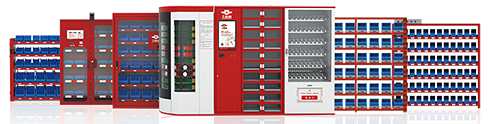
Open and Closed Smart Cabinet Use Cases in Factories
The choice between an open and closed smart cabinet should be based on how frequently an item is consumed, who is permitted to collect it, and whether the factory needs employee-level traceability.
Open cabinets are generally suitable for frequently used, low-risk materials that must remain immediately available. Closed cabinets are better for higher-value, restricted, safety-critical, or department-specific supplies. A hybrid deployment allows factories to maintain production speed without giving up inventory control.
Open Smart Cabinets for High-Frequency Fasteners
An open smart cabinet is especially suitable for frequently used materials that workers may need many times during a shift. Common examples include standard screws, bolts, nuts, washers, anchors, cable ties, rivets, clips, and other fasteners used on assembly lines, maintenance stations, and fabrication areas.
The main advantage is fast material pickup. Workers can identify the required bin, collect the necessary quantity, and return to the workstation without waiting for a storekeeper to unlock a cabinet or process a manual request. This is valuable in automotive production, machinery assembly, robotics manufacturing, electronics production, and general industrial maintenance, where a missing fastener can interrupt a task even when the item itself has a low unit cost.
When an open cabinet is connected to gravity sensing and digital inventory software, stock changes can be updated automatically. This creates a more reliable smart fastener inventory process and reduces dependence on handwritten records or delayed ERP entries. The system can also support shortage alerts and replenishment reminders, helping procurement teams respond before a commonly used fastener becomes unavailable.
A practical deployment method is to place open smart cabinets near production cells or high-consumption work areas. High-usage items can be assigned to clearly identified bins, while slower-moving materials remain in a central warehouse. This reduces unnecessary walking, supports point-of-use inventory, and improves factory material flow management.
Closed Smart Cabinets for Controlled PPE Dispensing
A closed smart cabinet is more suitable when a factory needs authorization, security, traceability, or controlled dispensing. A PPE dispensing cabinet may be used for safety glasses, respirators, cut-resistant gloves, hearing protection, welding accessories, protective clothing, lockout devices, and other items that require controlled access or usage records.
Workers can identify themselves through supported methods such as an ID card, QR code, password, or facial recognition, depending on the cabinet configuration. The system can record access activity and support traceable material issue. This gives safety, warehouse, and management teams a clearer view of who collected an item, when it was collected, and which material was issued.
Closed cabinets are also useful for higher-value fasteners, special components, precision tools, restricted consumables, or items reserved for specific departments. For example, a production area may need to separate standard hardware from special-grade fasteners. A maintenance department may need to restrict access to expensive cutting tools or controlled spare parts.
Physical containment and electronic locking help reduce unauthorized pickup and protect materials from dust, misuse, or accidental removal. Because closed smart cabinets can support 24/7 self-service, they are also well suited to multi-shift factories. Night-shift workers can collect approved PPE or maintenance supplies without waiting for a staffed storeroom, while managers retain digital records and inventory visibility.
Combining Open and Closed Cabinets in One Factory
The most effective solution is often a hybrid layout rather than choosing only one cabinet type. Open cabinets can serve fast-moving, low-risk items, while closed cabinets control materials that require authorization or stronger accountability.
A fastener-intensive factory might place open smart cabinets beside assembly lines for standard bolts, screws, nuts, washers, and clips. Closed cabinets can then be used for premium fasteners, special adhesives, precision tools, or components assigned to specific production orders.
In a PPE program, open bins may hold basic disposable items in supervised areas, while closed cabinets manage respirators, protective eyewear, specialty gloves, or department-specific equipment. The cabinet selection can also vary between workshops. A high-volume assembly area may prioritize fast access, while a maintenance storeroom may require stricter access control.
This hybrid approach allows the factory to match the storage method to the operational risk. It prevents over-controlling every low-cost item, which could slow production, while avoiding uncontrolled access to items that need better security or traceability.
Real-Time Inventory Visibility and Smart Replenishment
For factories with high material consumption, the cabinet itself is only part of the solution. The larger value comes from connecting storage equipment with an intelligent material management platform. Real-time inventory visibility allows warehouse and procurement teams to monitor stock levels, review consumption patterns, and identify unusual usage.
When inventory falls below a preset safety level, the system can generate a shortage reminder or replenishment request. This supports smart replenishment and reduces the need for repeated manual stock checks. It also helps prevent emergency purchases caused by inaccurate records or delayed reporting.
A connected system can provide material issue data, replenishment history, employee access records, and current stock status. These records support better supplier coordination and more accurate purchasing decisions. Over time, managers can use actual consumption data to adjust bin quantities, reorder points, cabinet locations, and material assignments.
The NVMI approach combines smart cabinet hardware, sensing technology, and digital management to support stock updates, shortage reminders, controlled pickup, and material traceability.
Recommended Cabinet Selection by Application
Open smart cabinets are a strong fit for production-line fasteners, maintenance consumables, frequently used MRO supplies, and high-volume materials with low access risk. They are especially effective where speed, convenience, and point-of-use availability are the main priorities.
Closed smart cabinets are better for controlled PPE dispensing, expensive consumables, restricted tools, special-grade fasteners, and materials that require employee-level accountability. They are also appropriate for unattended storerooms, 24/7 pickup areas, and environments where physical protection is important.
Before implementation, factories should classify materials according to consumption frequency, value, safety importance, access requirements, storage conditions, and replenishment method. This classification makes it easier to decide which items belong in open cabinets, which require closed cabinets, and which should remain in central storage.
Building a More Efficient Factory Material Flow
Factories that consume large quantities of fasteners and PPE need more than additional shelves or larger safety stock. They need a material access model that supports production speed while improving inventory control.
Open smart cabinets provide convenient access to high-frequency materials, while closed smart cabinets provide security, authorization, and traceability. By combining both cabinet types with real-time inventory tracking and smart replenishment, manufacturers can reduce manual work, improve stock accuracy, support 24/7 material pickup, and create a more visible digital supply chain.
The result is a practical path toward intelligent material management without forcing every item into the same control process. Each material can be stored according to its operational importance, allowing employees to access essential supplies efficiently while managers maintain the visibility needed for better planning and control.