Smart cabinet inventory accuracy matters most when someone has to act on the number. At shift change, a cabinet shows 12 retaining clips beside an assembly line. The replenishment coordinator sees enough stock for the next batch and skips the stop. The operator opens the bin and finds it empty. The clips cost little, but the decision to skip that bin was based on 12 pieces that nobody could pick.
For a factory using smart cabinets to manage screws, nuts, washers and other C-parts, the useful question is specific: how often can someone trust the quantity shown for a particular part in a particular bin? A physical count can answer that question, provided the team agrees on what to count, when to compare the numbers and which discrepancies need action.
Smart Cabinet Inventory Accuracy: The Quick Answer
Exact-match accuracy = SKU-location records that match the independent physical count ÷ SKU-location records checked × 100. Compare quantities in the same unit, at the same time, before anyone corrects the balance. If the same screw is stored in three cabinets, treat those as three records: stock in Cabinet A cannot fill an empty bin in Cabinet C unless someone moves it.
Key takeaways
- Report the exact-match rate and the within-tolerance rate separately. Each answers a different question.
- Show how many records were checked and how they were selected. A percentage from one cabinet does not describe the whole plant.
- List bins that showed available stock but were physically empty. These exceptions can change the next replenishment run even when the overall rate looks good.
Contents
- Define the record and the tolerance
- Run a blind cycle count during production
- Read the results of a 20-bin count
- Find the cause of a mismatch
- Read accuracy alongside four operating KPIs
- Decide whether a pilot is ready to expand
- Frequently asked questions
Define What One Inventory Record Represents
Start with the decision the record supports. If a supervisor uses the cabinet to release a production batch, the relevant figure is the number of usable pieces at that workstation. A sealed bag in receiving, an open bag awaiting inspection and a bag in the operator’s assigned bin may all appear in plant inventory. Only the last one is available for this pick. Write that definition on the count sheet so different shifts apply the same rule.
For each observation, record the part number, cabinet and bin identifier, counting unit, snapshot time, displayed quantity and independently counted quantity. Keep size and specification visible. A bin containing 100 M8 washers does not satisfy a record for 100 M6 washers, even if the quantities happen to agree. Likewise, if purchasing orders by the box and production picks by the piece, confirm the pack size before comparing the records.
Set any tolerance before counting. A plant might allow a small piece difference for a loose washer used by the handful and require an exact count for a retaining clip issued one per assembly. Ask production what happens if the displayed balance is wrong by that amount. A tolerance that conceals an empty bin or changes whether a job can start deserves another look. Targets and tolerances are plant decisions; a sensor specification alone cannot set them.
How to Check Smart Cabinet Inventory Accuracy During a Shift
- Select the bins before looking at the dashboard. Include fast-moving and slow-moving items, open and sealed packs, and more than one shift or location where relevant. Keep scheduled counts separate from investigations prompted by an alert. Otherwise, adding more problem bins to the investigation list can make an unchanged process appear to deteriorate.
- Save a timestamped balance. Pause movements at the selected bin long enough to count it, or log every pick, return and refill between the snapshot and the count. For example, if the snapshot shows 48 screws at 09:00 and an operator takes eight at 09:02, the expected count at 09:03 is 40. Preserve both the original snapshot and the intervening issue.
- Count independently and blind. Give the counter the location, part identity and unit without showing the expected quantity. For a weight-sensing bin, hand-count loose pieces or use verified pack quantities plus a count of the loose remainder. Reading the quantity from a second screen fed by the same sensor provides no independent check.
- Check in both directions. Go from the stock list to the cabinet to find recorded stock that is missing. Then inspect the selected cabinet for material with no matching record. A bag of clips on an unassigned shelf will never be found by checking listed bins alone. Log it as unrecorded stock and report it alongside the accuracy rate.
- Keep the original result. If a discrepancy needs a recount, retain the first observation, the verified result and the reason for any change. Count the location once in the KPI. Save the authorized stock adjustment separately so that the corrected balance does not become evidence that the original record was accurate.
Worked Example: Why 95% Within Tolerance Can Still Leave a Line Short
Suppose a team independently checks 20 SKU-location records, all counted in pieces. Seventeen match exactly. Two loose-washer bins have a preapproved tolerance of five pieces in either direction: one has three more washers than recorded, and the other has three fewer. The remaining bin shows 12 retaining clips and contains none. The clips require an exact match. These figures illustrate the calculation; they are not customer results or suggested targets.
| Measure | Result | What the supervisor learns |
|---|---|---|
| Exact-match accuracy | 17 ÷ 20 = 85% | Three of the 20 records differed from the physical count. |
| Within-tolerance accuracy | 19 ÷ 20 = 95% | Both washer bins passed the plant’s rule. The clip bin failed. |
| Total absolute difference | 3 + 3 + 12 = 18 pieces | The opposite washer errors are both visible. They would cancel in a net total. |
| Recorded stock in physically empty bins | 1 bin; 12 clips recorded | The replenishment coordinator has a specific location to check before the next batch. |
Each figure supports a different action. The shift lead needs the clip bin identified immediately. The analyst needs both washer discrepancies preserved: if the bins are adjacent, the opposite differences give the team a reason to check whether a handful was returned to the wrong bin. That is a hypothesis to test, not a reason to adjust both records without looking. The pilot owner needs the denominator as well: the result describes 20 checked records.
Trace a Discrepancy Before Changing the Balance
Start with the last event that both the material handler and the system can verify. Was a full pack delivered? Was an open pack returned? Did someone refill the neighboring bin? A difference of exactly one pack is a reason to check the receiving unit and the refill entry. Equal and opposite differences in neighboring bins suggest checking labels and returns. An error that appears just after shift handover calls for comparing timestamps with the physical movement log.
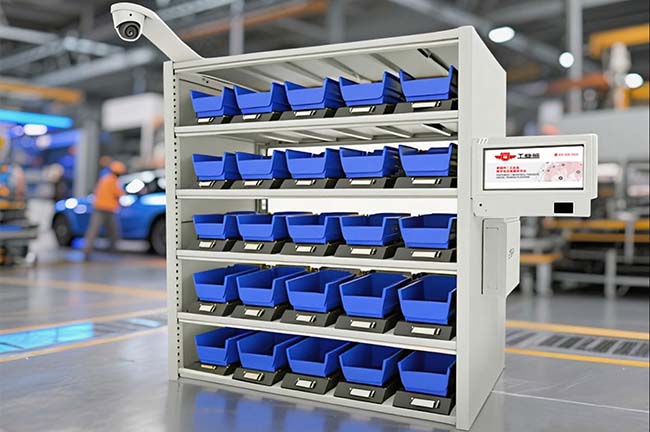
For a weight-sensing cabinet, also inspect what is actually on the sensing unit. Mixed parts, packaging left in a bin or a replacement container with a different empty weight are all worth checking. The NVMI-H open smart cabinet uses weight changes to track material movement and supports low-stock alerts. To verify a discrepancy, identify the part and count it independently before deciding whether the cause lies in the stock, the setup or the transaction record.
If the site exchanges data with an ERP or warehouse system, run two checks: physical stock against the cabinet, then the cabinet against the receiving system at the same cutoff. Agreement between two screens can coexist with an empty bin. Conversely, the physical and cabinet quantities may agree while an ERP posting is pending. The first finding belongs with the material-handling team; the second gives IT a specific transaction and timestamp to trace.
Read Inventory Accuracy Alongside Four Operating KPIs
Stock record accuracy tells you whether the balance is trustworthy. It does not tell you whether the factory bought the right amount or replenished the bin in time. A perfectly accurate zero can still stop a job. Use the following measures to distinguish a counting problem from a supply problem.
| KPI | Working definition for a C-parts cabinet | Question it helps answer |
|---|---|---|
| Consumption variance | Actual net pieces issued for production minus planned pieces for the output actually made, for the same part and period. | Did use rise faster than production volume? Check returns, rework and transfers before treating the difference as waste. |
| Stockout rate | Request lines that could not be filled in full because usable stock was insufficient ÷ total request lines. | How often was material unavailable when needed? Include failed picks, even if the operator took nothing for the cabinet to detect. |
| Inventory turns | Cost of in-scope materials consumed during the period ÷ average inventory value for those materials, on the same cost basis. | How quickly is the cabinet using the stock it holds? Compare like periods and keep the same material scope. |
| Slow-moving inventory share | Stocked SKUs with no qualifying issue during a defined review window ÷ stocked SKUs reviewed. | Which items warrant a space or reorder review? An infrequently used maintenance spare may still need to remain available. |
Consider two findings from the same weekly meeting. Bin A repeatedly runs empty, and its record correctly shows zero each time. Review its refill trigger, delivery schedule and recent demand. Bin B also runs empty, but its record stays positive. Investigate the record before raising the refill quantity. Increasing stock in both bins would spend money without explaining why Bin B’s signal failed.
Use the Pilot to Decide Whether to Expand
Before the pilot, take a baseline at the workstations the cabinet will serve. Use the same part identities, availability rules and counting units that you intend to use after installation. Repeat the checks over comparable shifts. If the baseline includes open packs on a busy assembly line but the follow-up includes only sealed packs in a storeroom, the two percentages cannot tell you whether line-side records improved.
Give the pilot owner a short report: records planned, records checked, exact matches, matches within tolerance, false-available bins and unresolved causes. Show skipped locations explicitly. If a bin was inaccessible during production, it is unverified; it is neither a pass nor a failure. When combining sites, add exact matches across sites and divide by total records checked. A small pilot cabinet should not carry the same weight as a site that checked hundreds of records.
Agree in advance on what evidence supports expansion. Production can specify which empty-bin events require immediate review. The warehouse can own the count schedule and corrections. IT can trace delayed postings where an interface is in scope. For each recurring discrepancy, assign an owner and check the location again on a later scheduled count. A corrected balance proves that someone made an adjustment; a later independent match is better evidence that the fix held.
Frequently Asked Questions
What is a good inventory accuracy target for factory C-parts?
Set the target from your baseline and the consequence of a wrong decision. A low-cost clip that can stop assembly may warrant a stricter rule than a higher-value item with an immediate substitute. Document the exact-match target, allowed tolerances and any exceptions that require action regardless of the overall score.
How often should a smart cabinet be cycle counted?
Start with the time between a bad balance and its likely effect on production. A bin emptied and refilled several times between weekly reviews deserves different coverage from a sealed reserve bin. Increase checks after a bin move, pack-size change or repeat discrepancy, while keeping a scheduled sample for trend reporting.
Does real-time inventory visibility mean that the quantity is accurate?
No. “Real time” describes how current a reading is. A recent reading can still be assigned to the wrong part number or reflect mixed contents. Check the last update time to assess freshness and use an independent physical count to assess accuracy.
How should we report a bin that shows zero?
For an assigned location in the sample, a recorded zero and a physical zero are an exact match. A recorded zero with a full bag on the shelf is a mismatch and can prompt an unnecessary refill. Report how many checked bins had a zero balance so readers can see whether the sample represented active pick locations.
References and Sources
The U.S. Government Accountability Office’s guide to accurate physical inventory counts provides background on independent counts and control of stock movements during counting. For project planning, compare smart cabinet configurations and explore the smart warehouse technology guides.
Plan the First Count Around a Replenishment Decision
A useful pilot starts at a bin where the recorded quantity changes someone’s next action: release a batch, send a refill or investigate a shortage. To scope a pilot with NVMI, bring the SKU list and material categories for one workstation, recent consumption history, your current KPIs and reporting frequency. Describe who picks, returns and refills material on each shift, what access they need and which system receives the balance. That gives the team enough context to choose the first bins, agree on a target and decide who acts when a count fails.