Can NVMI reduce stockouts without simply adding more inventory? For many manufacturers, the answer depends less on carrying a larger buffer and more on improving how quickly consumption becomes visible, how replenishment needs are identified, and who is responsible for acting on them. Stockouts often develop when physical inventory changes faster than manual counts, purchasing transactions, or supplier communications can keep up.
Vendor Managed Inventory addresses this problem by giving the supplier an agreed role in monitoring inventory or consumption data and planning replenishment within defined rules. Instead of treating every shortage as a reason to increase safety stock, manufacturers can improve the information and response loop between point-of-use consumption and supplier replenishment.
How Vendor Managed Inventory Reduces Stockout Risk Without Simply Adding More Stock
Quick Answer
NVMI can reduce stockout risk by shortening the time between material consumption, shortage detection, and supplier response. In a conventional process, the buyer may need to count inventory, recognize a shortage, create a request, place an order, and communicate with the supplier. In NVMI, the supplier can receive agreed inventory or consumption information and act according to predefined minimum, maximum, target, or other replenishment rules.
The objective is not guaranteed stockout elimination. Demand variability, supplier disruption, inaccurate data, production changes, and transportation delays can still create shortages. NVMI improves the replenishment process by making inventory conditions more visible and responsibilities clearer. Safety stock can remain part of the design, but it becomes one control parameter rather than the only response to uncertainty.
Key Takeaways
- Adding inventory can mask replenishment problems without correcting slow or inaccurate information flow.
- NVMI shifts agreed replenishment planning toward the supplier based on shared inventory and demand information.
- Timely inventory visibility can shorten the gap between physical consumption and replenishment decisions.
- Stockout prevention requires clear thresholds, reliable material data, defined supplier responsibility, and exception handling.
- Safety stock should be reviewed as part of a broader replenishment policy rather than increased automatically after every shortage.
- Smart bins and cabinets can provide digital inventory tracking, issue records, shortage reminders, and replenishment information.
Table of Contents
- Why stockouts happen even when inventory is high
- How NVMI changes the replenishment loop
- Why inventory visibility matters
- How supplier replenishment reduces delay
- The role of safety stock in NVMI
- How smart inventory technology supports stockout prevention
- How to design a practical NVMI policy
- What to measure after implementation
- Frequently asked questions
Why Stockouts Can Happen Even When a Plant Carries More Inventory
A stockout does not always mean the company purchased too little inventory overall. The problem can be caused by where inventory is located, when consumption is recorded, how replenishment is triggered, or how quickly the responsible party reacts.
Consider a factory that carries a substantial quantity of fasteners in a central warehouse. Production consumes the same fasteners at multiple line-side locations. The ERP may show stock at plant level, yet one workstation can still run out because the local location was not replenished in time. Increasing total stock would not necessarily correct that local material-flow problem.
Manual processes can create another delay. An operator removes parts, a warehouse employee notices a low quantity later, procurement reviews the requirement, and the supplier finally receives an order. Every handoff adds time between physical consumption and the external replenishment response.
Forecast error also matters. Safety stock and planned inventory depend on assumptions about demand, lead time, and variability. If actual usage changes because of a new production schedule, maintenance event, or unexpected demand, fixed parameters may no longer represent the real requirement. Effective stockout prevention therefore requires attention to the complete replenishment loop, not only the quantity on hand.
NVMI Reduce Stockouts by Improving the Replenishment Loop
A NVMI program changes who watches this loop. In a vendor-managed model, the customer shares agreed stock, consumption, demand, or sales information with the supplier, and the supplier uses that information to determine replenishment requirements. The manufacturer still defines the operating framework, but routine replenishment planning becomes more collaborative.
A practical industrial workflow may follow these steps:
- The buyer defines which materials and locations are included.
- Each material receives clear identification, location, supplier, and replenishment parameters.
- Production or maintenance personnel consume material.
- The inventory quantity or material-issue record is updated.
- The inventory position is compared with the replenishment rule.
- A shortage or replenishment condition becomes visible.
- The supplier reviews the information and plans the refill.
- The replenishment is delivered and recorded.
- Exceptions are reviewed when demand or supply falls outside the normal rule.
The value comes from connecting these events. If a plant automates stock counting but the supplier still receives information late, the response loop remains slow. If the supplier sees the data but nobody has defined replenishment responsibility, the process can still fail. Visibility and responsibility must be designed together.
Inventory Availability Starts With Better Visibility
Inventory availability is not the same as a monthly stock report. Procurement and operations need information that is timely enough to support the replenishment decision they are making.
For a high-frequency C-part, a quantity recorded during last week's cycle count may already be outdated. For line-side inventory, plant-level totals may not reveal a shortage at a specific workstation. For controlled MRO material, a warehouse balance may not show who removed an item or whether an unused quantity was returned.
Digital inventory capture can reduce this gap by recording material activity closer to the point of use. Managers can then review current conditions, consumption history, and exceptions instead of relying only on periodic physical checks. The required update frequency should still reflect material value, usage, criticality, storage format, and shortage impact.
Supplier Replenishment Can Remove Unnecessary Decision Delays
In a traditional process, the supplier may not act until it receives a purchase order or another formal demand signal. In NVMI, the supplier can monitor agreed inventory conditions and determine replenishment needs within established rules.
This can remove repetitive buyer-side decisions for suitable materials. Procurement can focus more on governance, supplier performance, exception management, and policy changes instead of manually reviewing every low-level signal.
For the supplier, earlier visibility creates both opportunity and responsibility. The supplier needs clear data, planning parameters, delivery rules, and an escalation path when normal replenishment cannot protect availability. Supplier replenishment works when the supplier knows what to monitor, what condition requires action, how much to replenish, and how to confirm the response.
Safety Stock Optimization Is Different From Simply Adding More Stock
Safety stock is a buffer against uncertainty. It can be appropriate when demand and replenishment lead time vary, but increasing it after every shortage can create higher inventory without addressing the underlying cause.
Before changing a safety-stock parameter, a NVMI team should ask why the shortage occurred. Was consumption faster than expected? Was the inventory record inaccurate? Was the replenishment signal late? Did the supplier miss the agreed response? Did packaging constraints affect the refill?
If the shortage came from delayed data, more safety stock may provide temporary protection while leaving the process problem untouched. If demand variability or lead time has genuinely changed, revising the buffer may be justified. Safety stock optimization in NVMI therefore means reviewing buffer levels together with actual consumption and replenishment performance, not minimizing or maximizing stock automatically.
How Smart Inventory Technology Supports Stockout Prevention
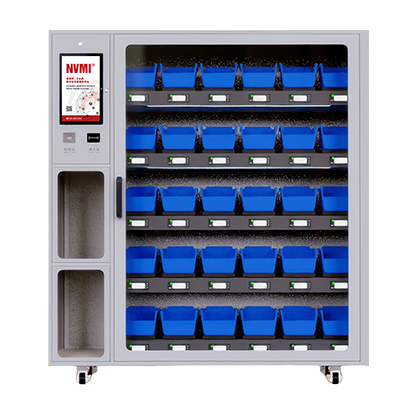
The NVMI smart inventory approach combines physical inventory equipment with SaaS-based material management. According to the available product documentation, the system can support real-time inventory updates, material usage records, shortage reminders, supplier replenishment information, and visual monitoring of material status.
These functions can strengthen NVMI because the point where material is stored can also become a source of replenishment data. Instead of waiting for a separate manual count before the supplier learns that stock is low, the inventory condition can be captured as part of normal material use.
Different environments may require different equipment designs. NVMI-H is an open smart inventory configuration intended for convenient material collection in locations such as warehouses and production lines. NVMI-D uses an enclosed cabinet structure for applications requiring greater access control and traceability. NVMI-X provides a mobile configuration for production environments where material storage may need to move with changing workstation requirements.
Manufacturers evaluating this workflow can review the vendor managed inventory solution to connect smart storage with supplier replenishment. Teams planning a wider material-management project can also use the smart warehouse technology resources when considering warehouse visibility and digital material flow.
Technology still needs an operating policy. A shortage alert needs an owner, an inventory value needs an agreed source of truth, and a supplier dashboard needs replenishment parameters. Hardware and software improve information flow; the NVMI agreement defines how people act on that information.
Practical NVMI Design Checklist for Stockout Prevention
| Design Question | Why It Matters |
|---|---|
| Which SKUs are included? | Defines the supplier-managed scope and prevents unclear responsibility. |
| Where is each SKU consumed? | Distinguishes plant-level stock from point-of-use availability. |
| How is consumption captured? | Determines how quickly physical usage becomes visible. |
| What triggers replenishment? | Defines the minimum, maximum, target, shortage, or other agreed rule. |
| Who receives the signal? | Ensures every requirement has a responsible owner. |
| How much is replenished? | Connects the trigger with target inventory and packaging constraints. |
| How are exceptions handled? | Creates a process for abnormal demand, data problems, or delayed supply. |
| Who owns the inventory? | Separates replenishment responsibility from consignment terms. |
| What systems exchange data? | Defines whether SaaS, ERP, MES, WMS, or supplier platforms participate. |
Where enterprise-system integration is required, the project should confirm the actual interface, data objects, authentication, protocol, update frequency, and exception behavior. APIs or standard protocols may be used where supported by the confirmed technical scope, but compatibility should not be assumed without project-level verification.
What Should You Measure After NVMI Deployment?
A stockout-reduction project should be measured against the plant's own baseline. There is no responsible universal percentage because results depend on material behavior, supplier capability, lead time, data quality, replenishment rules, and operating discipline.
Useful KPIs can include stockout events, emergency replenishment requests, replenishment response time, time between physical consumption and system visibility, inventory record completeness, manual counting workload, supplier exception frequency, and SKUs repeatedly operating outside agreed inventory parameters.
Inventory quantity should remain visible as a KPI because the goal is not to prevent shortages by quietly creating excessive buffers. If availability improves but average inventory rises significantly, the team should determine whether the improvement came from a better replenishment process or simply from carrying more material.
Frequently Asked Questions
Can NVMI Eliminate Stockouts Completely?
No. NVMI can improve replenishment visibility and responsibility, but no inventory model can responsibly guarantee that stockouts will never occur. Demand changes, supplier disruption, quality issues, transportation problems, inaccurate data, or unexpected operating events can still affect availability.
Does NVMI Reduce Stockouts by Increasing Safety Stock?
Not necessarily. NVMI can address stockout risk by improving inventory visibility, replenishment timing, supplier responsibility, and exception handling. Safety stock can remain part of the policy, but increasing it is only one possible response to uncertainty.
What Information Does a Supplier Need for NVMI Replenishment?
The supplier normally needs clearly defined material information and agreed inventory or demand data. Depending on the project, this may include current stock, consumption, minimum and maximum levels, target quantities, open replenishments, forecasts, and location information.
Which Materials Are Good Candidates for Stockout-Focused NVMI?
Frequently consumed standardized materials such as selected fasteners, C-parts, MRO consumables, and line-side supplies can be suitable when replenishment can follow repeatable rules. Material criticality, usage variability, supplier capability, and access requirements should also be considered.
Can Smart Cabinets Help With Stockout Prevention?
Smart cabinets and smart bins can help by providing timely inventory information, digital issue records, shortage reminders, and replenishment data. Their value depends on how those signals connect to a clearly defined buyer-supplier process.
Does a NVMI Project Need ERP Integration?
Not always. Some projects can operate through a dedicated SaaS material-management platform, while others require data exchange with ERP, MES, WMS, or supplier systems. The correct scope should be technically confirmed before deployment.
References & Sources
- Bear Bit NVMI product documentation: real-time inventory monitoring, material usage records, shortage reminders, replenishment workflows, SaaS material management, access control, and NVMI-H, NVMI-D, and NVMI-X deployment concepts.
- SAP Help Portal: Vendor-Managed Inventory — describes NVMI as a process in which customers provide stock and sales information and vendors determine replenishment requirements.
- SAP Help Portal: Supplier-Managed Inventory — describes replenishment planning using customer demand, inventory on hand, and agreed minimum and maximum stock levels.
- Inventory parameters, safety-stock policies, integration scope, ownership terms, and KPI targets should be validated for each manufacturing project rather than treated as universal values.
Conclusion: Reduce Stockout Risk by Fixing the Information and Replenishment Loop
The question of whether NVMI reduce stockouts should not be answered by assuming that a plant simply needs more safety stock. Vendor Managed Inventory can address delayed inventory visibility, repetitive buyer-side decisions, unclear replenishment responsibility, and slow communication between physical consumption and supplier action.
A strong NVMI program connects accurate material identification, timely inventory data, practical replenishment parameters, supplier responsibility, exception management, and the correct physical storage design. Smart inventory technology can strengthen this process by turning material activity into digital inventory and replenishment information, but the operating rules remain essential.
For a specification-driven evaluation, prepare your material categories, SKU list, monthly usage pattern, current stockout pain points, supplier model, existing replenishment workflow, user count, access-control requirements, integration scope, target deployment locations, and target KPIs. These inputs make it possible to determine where NVMI can improve inventory availability and where changes to safety stock, supplier processes, storage design, or internal material flow may also be required.