NVMI vs traditional inventory management is not simply a comparison between two ways to count stock. It is a comparison between two operating models for deciding who watches consumption, who triggers replenishment, how inventory information is shared, and how buyers and suppliers coordinate day-to-day material availability. For manufacturers managing fasteners, C-parts, MRO supplies, tools, and other high-frequency materials, the practical difference can affect workload, data visibility, replenishment discipline, and the speed of exception handling.
Traditional inventory management usually keeps most planning and replenishment responsibility on the buyer's side. Vendor managed inventory (NVMI) moves some of that operational responsibility toward the supplier, based on agreed inventory rules and shared consumption data. However, NVMI does not automatically determine inventory ownership, payment timing, or commercial risk. Those terms must be defined separately in the supply agreement.
NVMI vs Traditional Inventory Management: What Really Changes?
Quick Answer
In a traditional buyer-managed model, the plant or purchasing team normally monitors stock, creates replenishment signals, issues purchase orders, follows deliveries, and resolves shortages. In a NVMI model, the supplier receives agreed inventory or consumption information and takes a more active role in replenishment decisions within predefined rules. The buyer still controls requirements, service expectations, approved materials, access policies, and commercial terms, but routine replenishment can become more data-driven and collaborative.
The biggest change is therefore not "who owns the stock." It is who is responsible for watching the inventory position and acting on replenishment signals. Ownership can remain with the buyer, remain with the supplier under a consignment arrangement, or follow another contractual structure. NVMI and consignment can be combined, but they are not the same concept.
Key Takeaways
- Traditional inventory management usually places replenishment monitoring and ordering responsibility primarily on the buyer.
- NVMI gives the supplier a defined role in monitoring inventory or consumption and planning replenishment.
- Inventory ownership is a commercial rule, not an automatic feature of NVMI.
- Reliable NVMI depends on timely data, clear minimum and maximum rules, agreed exception handling, and responsibility boundaries.
- Smart bins, smart cabinets, and SaaS inventory platforms can provide the inventory and consumption data needed to make supplier-managed replenishment more practical.
- The best model depends on material criticality, consumption patterns, supplier capability, access-control needs, and integration scope.
Table of Contents
- How the traditional model works
- How NVMI changes the replenishment process
- What changes for the buyer
- What changes for the supplier
- Inventory ownership and settlement
- Data and system requirements
- Where smart inventory technology fits
- How to choose between the two models
- Buyer FAQs
How Traditional Inventory Management Works
In a conventional industrial replenishment process, the buyer is usually the central coordinator. Warehouse staff count or review stock, planners compare available quantities with requirements, purchasing creates orders, and the supplier responds to those orders. The exact workflow varies by plant, but the information flow is often initiated internally by the buyer.
This model can work well when the number of SKUs is limited, demand is predictable, material values are high enough to justify close manual attention, or the buyer wants to retain direct control over every replenishment decision. It can also be appropriate where suppliers do not have access to reliable consumption data or where commercial policies prohibit supplier participation in inventory planning.
The challenge appears when plants manage a large number of low-value, frequently consumed items. Fasteners, C-parts, PPE, maintenance consumables, electrical components, and line-side materials may each be inexpensive, yet a shortage can interrupt work. When replenishment depends on periodic counting, handwritten issue records, or delayed system entry, the buyer may spend substantial administrative effort simply maintaining visibility.
NVMI vs Traditional Inventory Management in the Replenishment Process
Under NVMI, the replenishment process is redesigned around shared information and agreed decision rules. Instead of waiting for the buyer to notice a shortage and issue a replenishment request, the supplier can monitor agreed stock or consumption data and prepare replenishment according to a defined policy.
A practical industrial NVMI workflow may include several control points: identifying the material, tracking quantity changes, comparing inventory with a minimum or target level, generating a shortage or replenishment signal, confirming the required quantity, delivering or refilling the material, and recording the replenishment. The exact process should be agreed by both parties rather than assumed.
This is why NVMI should be treated as an operating model, not as a promise of automatic savings. Its value depends on the quality of the rules and data behind the process. If SKU master data is inaccurate, replenishment thresholds are unrealistic, or responsibilities are unclear, moving responsibility to the supplier does not solve the underlying problem.
What Changes for the Buyer?
For procurement and supply-chain teams, NVMI can reduce the need to manually initiate every routine replenishment event. The buyer's role shifts toward defining governance: which materials are in scope, which suppliers participate, what service rules apply, what inventory levels are acceptable, how exceptions are escalated, and how performance is reviewed.
Warehouse and production teams also need a disciplined material-issue process. If actual withdrawals are not captured, the supplier cannot make good replenishment decisions. This is particularly important for line-side locations and decentralized storerooms where materials may move faster than traditional ERP transactions are recorded.
Buyers should also retain visibility. A NVMI program should not create a black box in which the supplier sees the stock position but the plant does not. Shared dashboards, issue records, inventory status, shortage alerts, and replenishment history can help both sides work from a consistent operating picture.
What Changes for the Supplier?
The supplier moves from mainly responding to purchase orders toward actively monitoring agreed inventory conditions. That can mean reviewing consumption trends, responding to replenishment signals, planning refill quantities, and coordinating delivery timing with the plant's operating rules.
This added responsibility requires dependable data access and clear boundaries. The supplier needs to know which data is authoritative, how often it updates, what happens when actual demand deviates from normal usage, who approves material substitutions, and how urgent shortages are handled. Suppliers should not be expected to infer production plans or engineering changes from inventory levels alone.
For distributors serving many industrial locations, a digital NVMI process can also standardize replenishment workflows across sites. However, the model should still allow site-specific parameters because material criticality, storage capacity, access restrictions, and usage patterns can differ significantly by factory.
Inventory Ownership Is Separate from NVMI
One of the most common misunderstandings in NVMI vs traditional inventory management is the assumption that NVMI always means the supplier owns the inventory until it is consumed. That arrangement is usually associated with consignment, and it may be combined with NVMI, but it is not required.
| Decision Area | Traditional Buyer-Managed Inventory | Vendor Managed Inventory |
|---|---|---|
| Inventory monitoring | Primarily monitored by buyer teams | Supplier may monitor agreed stock or consumption data |
| Replenishment trigger | Usually initiated by buyer processes | Can be initiated by supplier according to agreed rules |
| Inventory ownership | Defined by purchase and receipt terms | Still defined by contract; NVMI does not determine ownership |
| Data sharing | May be limited to orders, forecasts, and delivery information | Typically requires more direct inventory or consumption visibility |
| Routine buyer workload | Buyer frequently monitors and initiates replenishment | Buyer focuses more on governance and exceptions |
| Supplier role | Responds mainly to buyer orders | Participates actively in replenishment planning |
Before implementation, procurement should document when title transfers, when invoices are created, how discrepancies are handled, who bears obsolescence risk, and how returns or engineering changes are treated. These are contractual questions and should not be left to the inventory system to define.
The Data Requirements Behind Supplier Managed Inventory
NVMI is only as reliable as the data used to drive replenishment. At minimum, both parties need consistent material identification, location information, current inventory status, and a defined replenishment rule. More advanced projects may also use consumption history, minimum and maximum quantities, supplier lead-time assumptions, open replenishment records, and exception flags.
System integration can range from simple dashboard access to API-based data exchange between shop-floor inventory systems and ERP, MES, WMS, or supplier platforms. The technical design should be confirmed for each project because not every plant exposes the same systems, data objects, security rules, or interface methods.
A practical implementation should first define the data object and workflow, then decide the integration method. For example: Which system is the source of truth for the SKU master? Which event counts as consumption? Does a material return increase available inventory immediately? Who closes a replenishment task? What happens if a device is temporarily offline? Answering these questions is more important than starting with a software brand name.
How Smart Cabinets and Smart Bins Support NVMI
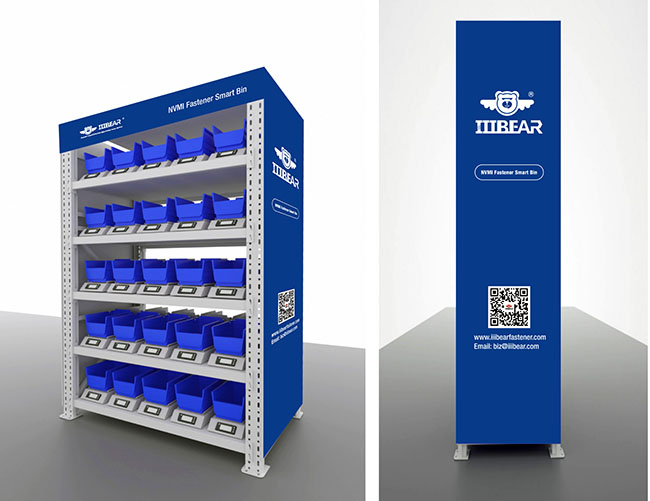
Digital point-of-use inventory technology can reduce the time gap between physical material movement and system visibility. The NVMI approach combines smart inventory hardware with SaaS-based material management so that inventory changes, material issue records, and replenishment signals can be captured closer to where consumption occurs.
For open-access storage, the NVMI-H concept is designed for warehouse, production-line, and transit material management where fast access is important. For controlled materials, the enclosed NVMI-D model can support authorization, access records, and traceability workflows. The NVMI-X mobile configuration is designed for production environments where point-of-use inventory may need to move with workstation or line-side requirements.
The system described in the product documentation supports real-time inventory updates, material usage records, shortage reminders, supplier replenishment workflows, and visual material-status monitoring. These capabilities can provide a digital foundation for smart replenishment and industrial inventory control, but they do not replace the need for clearly agreed NVMI responsibilities and commercial rules.
How to Choose the Right Model for Your Plant
Traditional inventory management is not automatically outdated, and NVMI is not automatically better. The best choice depends on the operational problem you are trying to solve. A useful evaluation starts with the materials rather than the software.
- Choose candidate SKUs: Identify fasteners, C-parts, MRO items, PPE, tools, or other materials with repeated replenishment activity.
- Map current work: Document who counts stock, who creates orders, how often quantities are updated, and where delays occur.
- Assess demand behavior: Separate stable, repetitive consumption from project-driven, highly irregular, or engineering-controlled demand.
- Define control requirements: Decide whether materials can be openly accessed or require authentication, issue records, or controlled return.
- Check supplier readiness: Confirm whether the supplier can monitor data, replenish to agreed rules, manage exceptions, and support the required locations.
- Define data ownership: Agree which system is authoritative for SKU, inventory, consumption, and replenishment status.
- Separate commercial rules: Document inventory ownership, settlement, obsolete stock, returns, and liability independently from the NVMI workflow.
- Set measurable KPIs: Examples may include stockout events, replenishment response time, inventory record completeness, emergency order frequency, and manual transaction workload. Targets should be project-specific rather than assumed.
A pilot can be useful when the plant has many material categories or multiple suppliers. Start with a manageable set of SKUs and locations, verify that the data reflects physical movement, test exception handling, and review whether buyer and supplier responsibilities are actually clear. Only then should the same replenishment logic be scaled to additional areas.
Where NVMI Creates the Most Operational Change
The strongest candidates are often materials that create disproportionate administrative work compared with their unit value. A plant may have thousands of small components whose individual cost is modest but whose availability matters to production or maintenance. In these environments, the operational question is less about optimizing each purchase order and more about maintaining reliable material flow with less manual intervention.
NVMI can be especially relevant for line-side fasteners, shared MRO storerooms, maintenance consumables, and supplier-supported C-parts programs. Controlled dispensing may be more important where materials are high-value, restricted, quality-critical, or frequently issued to individual users. Mobile inventory points can make sense where the production layout changes or materials need to follow a workstation. The replenishment model and storage architecture should therefore be designed together.
Frequently Asked Questions
Does NVMI Mean the Supplier Owns the Inventory?
No. NVMI describes who manages or participates in replenishment decisions. Inventory ownership is a separate commercial arrangement. A NVMI project may use buyer-owned stock, supplier-owned consignment stock, or another agreed structure.
Does NVMI Eliminate Purchase Orders?
Not necessarily. Some NVMI workflows still use purchase orders, blanket orders, scheduled releases, or other procurement documents. The replenishment process and the commercial transaction process should be designed together with procurement and finance.
What Data Does a Supplier Need for NVMI?
At a minimum, the supplier usually needs reliable material identification, location, inventory or consumption status, and replenishment rules. Additional information may include minimum and maximum levels, replenishment history, forecasts, or exception signals depending on the project.
Can NVMI Work Without ERP Integration?
It can, depending on the scope. Some projects begin with a standalone inventory platform or shared dashboard. Larger deployments may exchange data with ERP, MES, WMS, or supplier systems through supported interfaces. Integration requirements should be confirmed technically for each site.
Which Materials Are Good Candidates for NVMI?
Common candidates include frequently replenished fasteners, C-parts, MRO supplies, PPE, maintenance consumables, and other industrial materials where stockouts or repetitive manual ordering create operational friction. The final scope should also consider criticality, consumption stability, supplier capability, and storage controls.
Should a Manufacturer Replace All Traditional Inventory Management With NVMI?
Usually there is no need to treat the decision as all-or-nothing. Many plants can use NVMI for selected categories while retaining traditional buyer-managed control for strategic, highly variable, engineering-sensitive, or project-specific items.
References & Sources
- Bear Bit NVMI product brochure: product architecture, smart-unit configurations, real-time inventory monitoring, material usage records, shortage warnings, replenishment logic, and H/D/X application concepts.
- General NVMI operating concepts are used to explain buyer and supplier responsibility boundaries, inventory ownership, and replenishment governance. Commercial terms should be confirmed for each project.
Conclusion: Build the Replenishment Model Before You Automate It
NVMI vs traditional inventory management comes down to responsibility, data, and replenishment governance. Traditional inventory management keeps more monitoring and ordering activity inside the buyer's organization. NVMI gives the supplier a more active role in watching inventory conditions and replenishing materials according to agreed rules. Neither model removes the need for clear ownership, accurate data, exception handling, and commercial controls.
If you are evaluating NVMI for industrial materials, start with a specific operating scope. Share your material categories, SKU count, usage pattern, current stockout pain points, supplier model, deployment locations, user count, access-control needs, required system integration, and target KPIs. Those inputs make it possible to design a practical smart inventory and replenishment workflow instead of forcing every material into the same model.